

Hard tech, venture capital, and systems engineering
By Paolo Tomassone
When Spencer Greene, Partner at TSVC - the seed fund behind early rounds in Zoom, Carta, and Ginkgo Bioworks - tells a room full of engineers, founders, and investors that "capital is rotating into hard tech because AI is commoditizing software" he isn't being contrarian. He's describing a structural market dislocation that most players have yet to fully internalize.
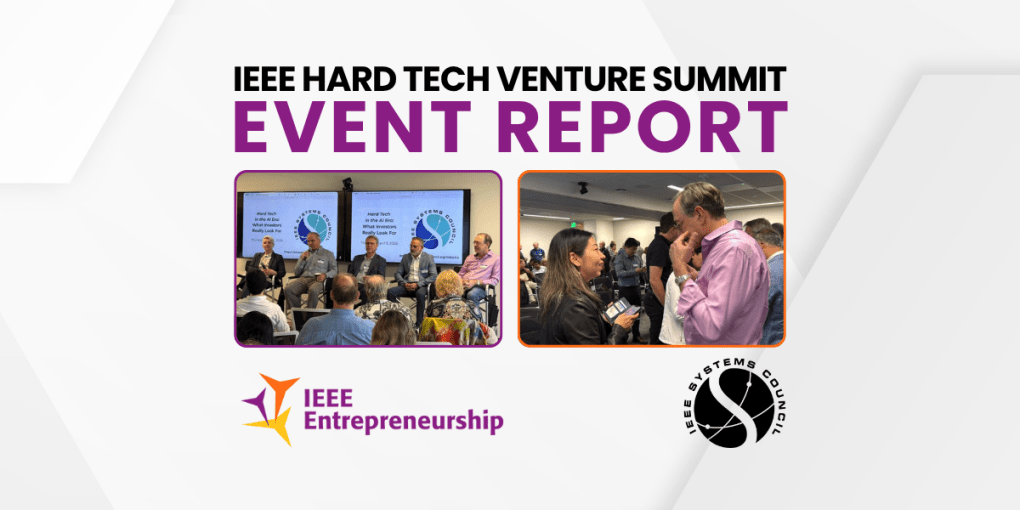
At the offices of Procopio Cory Hargreaves & Savitch in Palo Alto, the panel "Hard tech in the AI era: what investors really look for" brought together some of the most active investors in deep tech, robotics, and advanced hardware. Organized by the IEEE Systems Council Industry Committee and led by Bruno Iafelice, committee Chair, this event is part of a broader initiative that IEEE Systems Council is developing within some of the world’s most active innovation ecosystems, starting from Silicon Valley. A deliberately curated, high-signal event: exactly the kind of gathering IEEE Systems Council intends to scale, building meaningful bridges between its technical community and startup founders, venture funds, and established industries reshaping the boundaries of technological innovation.
Software is saturating. Capital is coming back to atoms.
The choice of hard tech as the focus of this engagement is deliberate. Robotics, sensors, photonics, power electronics, semiconductors, energy storage, space, defense: these are domains that by definition require the integration of multiple disciplines and subsystems. There are no partial solutions, only systems that work or systems that don't. This is where capital is flowing, and the underlying logic is sound.
"AI is commoditizing software - said Greene -. The truly defensible opportunities are in the physical world. And capital is starting to figure that out". Alexander Fries, General Partner at Ecosystem Ventures, broadened the lens: "Sectors like defense, neurotech, AR optics, and space are attracting growing attention and capital deployment. The new space economy alone is potentially doubling the size of the global economy. These aren't niche markets, they're the next frontier".
Muffi Ghadiali, Partner at i3 Ventures and Operating Partner at Blackhorn Ventures, added the enabling layer: "AI is reducing complexity and cost on the hardware side, freeing teams to focus on electromechanics and go-to-market execution. Problems in computer vision that were computationally intractable just a few years ago are now solvable. That fundamentally changes the capex calculus for a hardware startup".
The point of maximum skepticism: how hard tech is actually funded.
One of the sharpest frameworks to emerge from the day came from Spencer Greene, who introduced the concept of the "Point of Maximum Skepticism": "Every fundraising stage is defined by the moment when investor skepticism peaks around a specific risk. Your job isn't to move to the next labeled stage on a term sheet, it's to demonstrate you've retired that risk".
The proof points that matter differ sharply by company type. For software: "Three sales reps consistently hitting quota. Not one, not two - three. That's the signal you have a repeatable, scalable sales motion, not just a founder who can sell". For hardware and robotics: "Manufacturability, yield, and tolerance repeatability. A prototype that works once in the lab is worth nothing. It's worth something when it works a thousand times in a row, on the factory floor, operated by people who aren't your engineers".
Michael Harries, Partner at The Robotics Hub Fund, reinforced this with a recommendation that runs counter to the pace typically expected in venture: "Before we invest, we often spend months working alongside teams to validate the risk sequencing. Does regulatory risk get retired before technical risk? Does technical risk get retired before customer risk? The order in which you sequence risk mitigation determines how much runway you need, and how much capital you'll burn working on the wrong problem".
The practical takeaway shared across the panel: "Raise the minimum capital required to hit the next de-risking milestone. Don't optimize for round valuation. Optimize for the clarity of the proof point that unlocks the next round".
Pilot Purgatory: the quiet graveyard of hardware startups
One topic drew unanimous recognition across the room, what moderator Andra Keay, Managing Director of Silicon Valley Robotics, labeled with surgical precision: "innovation theater".
"Corporates love to signal innovation - said Keay -. The problem is when that performance comes at the expense of a startup that genuinely believes in the partnership". The phenomenon has a name in the ecosystem: pilot purgatory. A large industrial player launches a pilot program. The pilot runs. Feedback is positive. But a commercial contract never materializes, and neither does a clean rejection. The startup burns through runway and credibility. The corporation has effectively received subsidized R&D.
Ghadiali was blunt: "If there's no clear pathway to commercial conversion, the pilot isn't worth your time. You're teaching someone to do your job, for free". The panel converged on three operational principles to avoid the trap: always get the operational business unit - not just the corporate venture arm - at the negotiating table; require a written test plan with defined KPIs, timelines, and explicit post-pilot commitments; and be prepared to walk away if those conditions aren't met.
Fries closed with a distinction that functions as a standing rule: "As a distribution channel or a strategic design partner, CVCs are genuinely valuable. As lead investors controlling your cap table and responding to strategic priorities that shift with every C-suite transition, they're a liability".
IEEE Systems Council: engineering the system, not just the components
What makes this type of initiative consistent with IEEE Systems Council's mission goes beyond the relevance of the topics covered. It's the underlying approach: bringing the IEEE technical and scientific community into direct engagement with industrial players building the technological systems of the future, in one of the most dynamic and competitive innovation environments in the world.
A commitment that continues in Silicon Valley with the Hard Tech Venture Summit organized in partnership with IEEE Entrepreneurship, another opportunity to expand the network connecting innovators, investors, and systems engineers.